
When it comes to tourist destinations it may not be the most obvious top ten list, but when you think about it there are a lot of wonders of the world which are actually tombs (pyramids anybody??). Here is a list of the top ten tourist tomb destinations in the world.
10. Catacombs, Paris

Paris lies over deposits of Lutetion limestone. Over the centuries since it was founded the residents have mined down to the deposit and then dug tunnels through it. These tunnels were unmapped and randomly arranged, and became known as the Catacombs. In 1774 a number of collapsed houses prompted investigation and repair of these abandoned mines. Six years later a basement adjacent to a cemetery collapsed under the weight of the graves within it. Burials became banned within the city walls, and within a few years the decision was made to transfer any existing remains within the city cemeteries into the catacombs. Two years were taken in carrying millions of ancient Parisian corpses into the newly created Ossuary.
Today visitors to the Catacombs are welcome, as long as they are fit and healthy. There are 131 steps down, and 112 steps back up. The Catacombs are not wheelchair accessible, and it is not recommended for disabled visitors, pregnant women, sensitive individuals, or young children. This tomb is definitely one of a kind, and certainly something to visit if you are in Paris.
9. Mausoleum of the Shirvanshahs, Azerbaijan

Located in Baku, the capital of Azerbaijan, this palace complex was built in the 15th century. Part of the complex is the Palace Mausoleum. It was originally built for the mother and son of Shirvanshah Kahlilullah, but there are also other members of the Shirvanshah’s family buried there. His wife, Khanika Khanim, his son, Farrukh Yamin, and his mother, Bika are buried in three of the seven graves. Further graves of Sheikh Salah (aged two), another son of the Shirvanshah, and Ibrahim II are found. Finally a large skeleton belonging to a man of 2.1 metres in height is found opposite the only entrance. It is believed that this belongs to the Shirvanshah himself.
The Mausoleum itself is a beautiful architectural building and well worth a trip.
8. Tomb of Cyrus, Iran
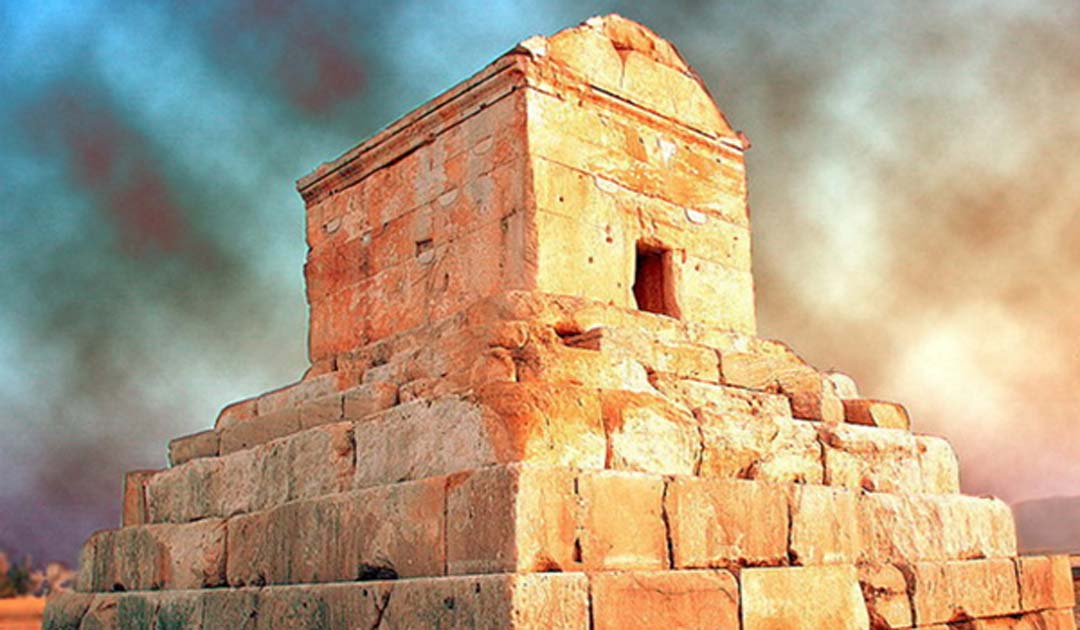
Cyrus the Great founded and ruled the Persian Empire in around 560 BC. He was seen as a great ruler, allowing the people that he conquered to retain their own customs and religions. His tomb is located in his capital city of Pasargadae, now in ruins. It is an impressive structure for the time.
Cyrus’ tomb was not identified until the early 19th century. Until then it was thought to belong to the mother of Solomon, probably a result of quick thinking in order to save the tomb from foreign invaders many centuries earlier. A description of the tomb by the discoverer, Porter, describes it as being a ‘ziggurat’ (a stepped pyramid) surmounted by a rectangular stone chamber with a low entrance. An earlier description from the 2nd century talks about the golden sarcophagus and an inscription saying that it was Cyrus buried at the tomb. These have never been found.
7. Panteon de San Miguel Cemetery, Mexico

San Miguel Cemetery is the colloquial name for the Panteon General in Oaxaca, Mexico. It was originally established in 1829 to provide capacity for a smallpox outbreak which killed one quarter of the city population. There are over 11,000 residents of the cemetery currently.
A major festival centred on this cemetery is the Dia de Muertes, Day of the Dead. Within a celebratory atmosphere thousands of families fetch picnics together with streamers, colourful signs, candles, and flowers with which to decorate the cemetery.
6. Castel Sant’angelo, Italy

This towering mausoleum was built on the Tiber, Rome, in the 2nd century for Roman Emperor Hadrian. Following his death, and until 217 AD, his successors were placed there as well. In 401 AD the tower was converted to a military fortress. At this time many of the artefacts were lost.
Now this top tomb is a museum. It has a medieval weapon display, the original tombs of the emperor, the prison cells, a museum floor with furniture etc, a floor purely of apartments for the pope to get to in an emergency, and the roof terrace with the famour archangel Michael bronze statue.
5. Tomb of Agamemnon, Greece

This tomb is an ancient beehive tomb built in the Bronze Age at around 1250 BC. It is built into the side of Panagitsa Hill in Mycenae and the interior is made up of a large dome approximately 14m in diameter. This was the largest dome in the world for over 1000 years until the Panthen was built in Rome. For a sense of scale, the stone lintel above the door weighs 120 tons, is over 8 metres in length, and is the largest in the world. It is called either the Treasury of Atreus or the Tomb of Agamemnon.
The king buried here is unknown, but is most likely not Agamemnon, and is probably also not Atreus. It was not a treasury, although would likely have held some treasure belonging to the inhabitant.
4. Taj Mahal, India

The Taj Mahal is a beautiful palace in Agra, India. It was built in 1648 by 20,000 artisans, costing an equivalent 53 billion rupees in today’s money. It was made in the honour of the Emperor Shah Jahan’s third wife, his most beloved, after she passed away during the birth of their fourteenth child together.
This palace lies along the bank of the Yamuna River, and sees more than 7 million visitors each year. It is a UNESCO World Heritage Site and one of the New 7 Wonders of the World. It lies within a 42-acre complex and formal gardens. As well as his princesss, Emperor Shah Jahan was also interred here after his son deposed him.
3. Mausoleum of the First Qin Emperor, Xi’an, China

The first Qin Emperor (Qin Shi Huang) lived in the third century BC. When he was aged 13 he ascended the throne and work on his mausoleum began. It was modelled on the capital of the Qin, Xianyang and is made up of an inner and outer city. It was first uncovered in 1974 and has not been fully excavated yet. The tomb itself is very much untouched, but is known to be located inside an underground palace.
The most striking feature of this mausoleum is the army of terracotta warriors which guard the tomb. Over 7,000 lifesize terracotta statues and 100 wooden battle chariots have been found so far. It was reported that after the first Emperor was interred in his tomb his concubines with no sons were sealed in with him, and the workers and craftsmen who constructed the tomb were trapped inside immediately after the funeral.
2. Giza Necropolis, Egypt

The Pyramids in Giza, Egypt, comprises the Great Pyramid of Giza, the Pyramid of Khafre and the Pyramid of Menkaure. It also contains the various pyramid complexes and the Great Sphinx. These impressive constructions are over 4500 years old and are the only one of the Ancient Wonders of the World still in existence.
The Pyramids were primarily built as tombs for three different Pharoahs, Khufu, Khafre and Menkaure. They were intended to protect the remains of the Pharoahs and their possessions while they prepared to move on to the afterlife. They don’t only hold those three people, though, there are many thousands of other burials at the sites, including favourite wives and servants, workers on the Pyramids, and various family members.
1. Westminster Abbey, England

Westminster Abbey is a memorial to many famous Englishmen and women, and holds the remains of 30 kings and queens from throughout the centuries. In its current form it dates back to 1245 and has been the location of many significant events of English royalty since.
Visitors to the Abbey will be able to visit the graves and memorials of thousands of people, including Elizabeth I of England, Edward the Confessor, Sir Isaac Newton, Sir Charles Barry, Charles Dickens, Rudyard Kipling, Charles Darwin, Laurence Olivier, and the Unknown Warrior. In addition to paying homage to these giants of their times, the architecture and history of the Abbey is magnificent.
This tomb is a must-see for any visitors to London.
This is really interesting, You are a very skilled blogger. I have joined your rss feed and look forward to seeking more of your fantastic post. Also, I have shared your site in my social networks!